


Should a wisdom tooth be treated or extracted?
A wisdom tooth (the third molar) certainly does not make you any cleverer, or any wiser.
 Dr. Cezar SindilăCoordinating dentist

The name “wisdom tooth” is empirically linked to age, since these molars usually come through between the ages of 17 and 25.
Functionally, wisdom teeth play a minor role. They are a remnant of primitive humans, who used these teeth to chew tough, fibrous food. Later, when people changed their eating habits, these teeth lost their purpose.
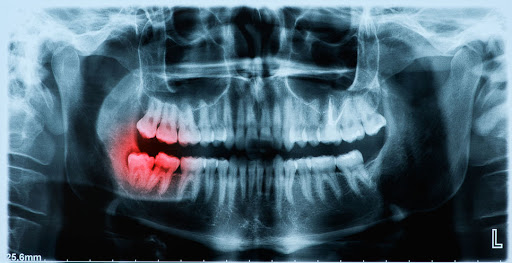
A person can have four wisdom teeth, three, two, one or none. What is certain is that nobody can have more than four. They are positioned symmetrically, at the far ends of the dental arches.
Extracting wisdom teeth is a controversial subject that often misleads patients. In many situations they are extracted preventively, because they are much more exposed to dental problems than other teeth.
In reality, extraction is needed in the following situations:
- The molar has extensive decay
- The molar does not have enough room on the arch to come through
- The molar affects the health of the neighbouring teeth
- The molar has no opposing tooth to bite on
- The molar causes gum problems
- There are soft tissue infections behind the wisdom tooth
- The neighbouring teeth are shifting
- The molar is associated with certain cysts
What to expect:
- A painless procedure, because it is done under local anaesthesia
- The procedure is short if the dentist has assessed the case correctly
- The extraction site is stitched for effective healing
- After the extraction, discomfort is moderate, because you will be prescribed anti-inflammatory and pain-relief medication, possibly also an antibiotic
After the procedure:
- Keep the gauze over the socket for 30-45 minutes
- Clean your teeth and mouth properly from the day after the procedure
- Chew on the side opposite the extraction
- Avoid fizzy drinks in the first days after the procedure
- Eat soft food served at room temperature (3-5 days)
- Rinse with room-temperature sage tea or a saline solution (warm water with salt)
- Apply cold compresses to the cheek to reduce the risk of swelling
- Come back to have the stitches removed 7-10 days after the procedure


